
October 17, 2026
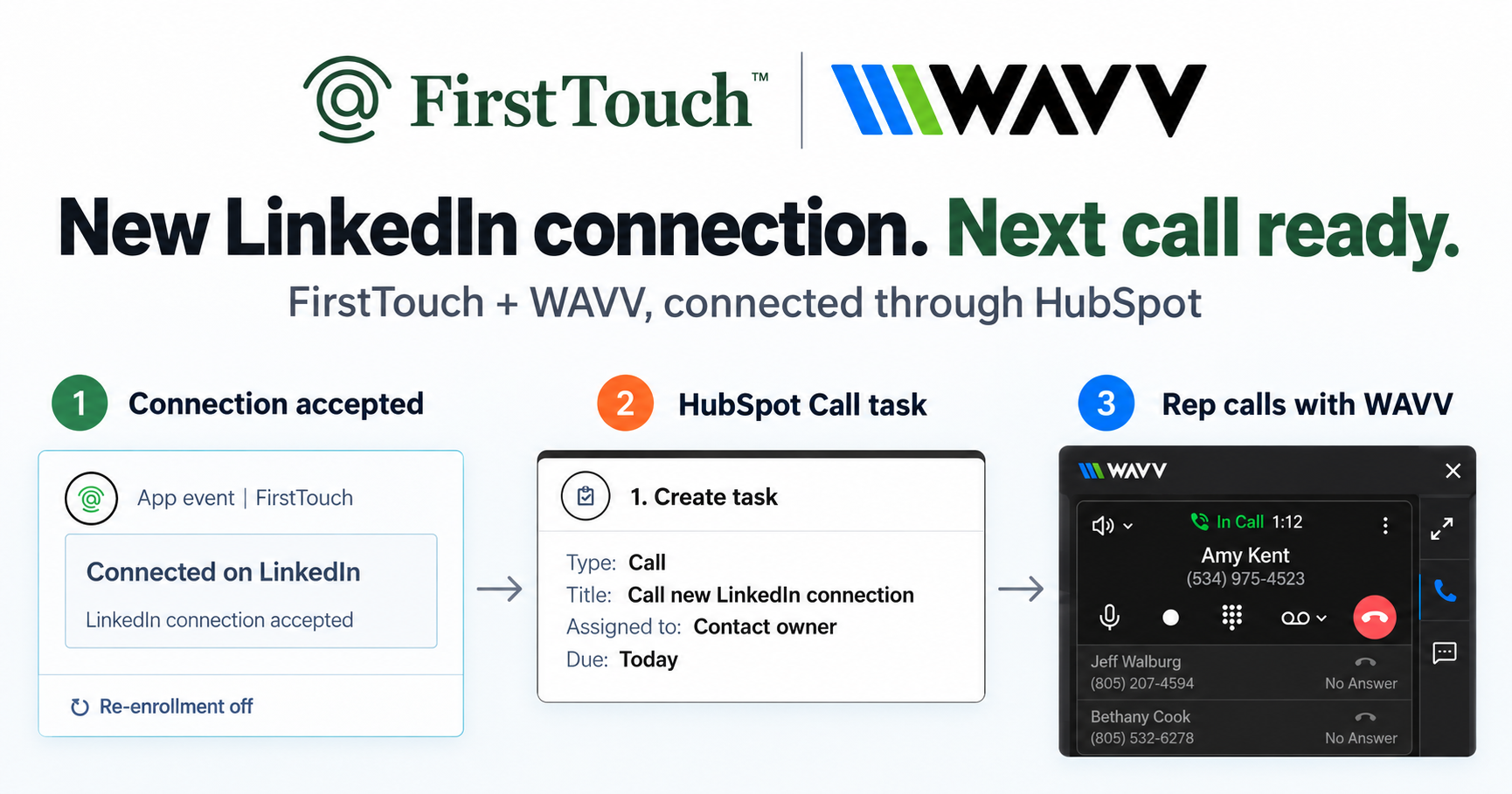
Turn LinkedIn connections into calls with WAVV and FirstTouchTurn an accepted LinkedIn connection into a HubSpot Call task, then make the call with WAVV inside HubSpot. A simple FirstTouch and WAVV workflow.
How-To
READ MORE

The best AI sales tools for mid-market teams in 2026 by job: Apollo, HubSpot Breeze, Gong, Clay, Clari, and FirstTouch for LinkedIn execution.
The best AI sales tools for mid-market teams in 2026 are Apollo for prospecting data and email, HubSpot Sales Hub with Breeze for CRM-native AI, Gong for conversation intelligence, Clay for enrichment, Clari for forecasting, and FirstTouch for LinkedIn execution, which is the one job the other roundups leave out entirely. FirstTouch is the HubSpot-native execution layer for LinkedIn outreach and tracking. Nobl9 calls it a game-changer for social selling that solved their cold email struggles with authentic LinkedIn outreach and seamless HubSpot integration.
An AI sales tool is any platform that uses machine learning to find buyers, decide who to contact, write the message, execute the touch, or predict the outcome. That definition covers five genuinely different products, and the confusion in this category comes from selling all five under one label. A conversation intelligence platform and a LinkedIn execution layer share almost nothing except the word AI in their marketing.
The five jobs worth separating are data (who exists and how to reach them), engagement (running the sequence), execution (performing the touch on the channel), intelligence (what happened on the call), and forecasting (what closes). Mid-market teams overspend when they buy two tools for one job and none for another.
Because the category was mapped around email and the CRM before social outreach became a primary channel, and the roundups still reflect that map. Mutiny's buyer guide for B2B go-to-market teams names thirteen tools across content, intent, conversation intelligence, enablement, CRM-native AI, engagement, and forecasting. Not one of them executes LinkedIn outreach. ZoomInfo's roundup names twelve, and only LinkedIn Sales Navigator and Salesloft mention the platform at all.
That second detail is the one worth checking, because it is where the category quietly concedes. Salesloft's LinkedIn Sales Navigator steps must be run manually and cannot be automated, and the integration requires at least a Sales Navigator Core license before you get lead list syncing or the embedded Sales Navigator panel. HubSpot's own Sales Navigator integration works the same way: it adds manual tasks to a sequence. So when a roundup says a platform supports multichannel cadences including LinkedIn, what shipped is a to-do item in a rep's queue. The rep still opens a browser tab and types.
A to-do item is a real feature. It is not automation, it is not attribution, and it is not what the buyer reading "multichannel" thinks they are getting.
FirstTouch fills the execution slot the rest of the stack leaves empty, inside HubSpot rather than beside it.
Pricing is 99 dollars per sender per month plus usage credits: 1 credit per profile for Contact Discovery, 2 for an email unlock, 7 for a phone unlock, 0.25 for email verification, 0.25 for AI message generation, and 1 each for the Qualification and Researcher agents.
Buy one tool per job, starting with the bottleneck you can name out loud. A 5 to 50 rep team running on HubSpot typically needs four purchases, not nine, and the order matters more than the brands. Below is each category with the honest leader and where it stops.
Apollo is the best value entry point for teams that want a contact database, sequencing, and a dialer in one subscription. Pricing runs 49 dollars per user per month on Basic, 79 on Professional, and 119 on Organization billed annually, with a free plan and a three-user minimum on Organization. Credits and add-ons push the real bill above the sticker. Apollo's LinkedIn support is a Chrome extension for capturing profile data, not a sending engine, so it sources well and stops before the social touch.
If HubSpot is already your system of record, Breeze is the lowest-friction AI you can turn on. Sales Hub Professional is 90 dollars per seat per month billed annually plus a one-time 1,500 dollar onboarding fee, sequences are gated at Professional, and Breeze Intelligence enrichment is a paid credit pack rather than an included feature. HubSpot's native LinkedIn support is the Sales Navigator manual task described above.
Gong is the category leader for recording, transcribing, and analyzing sales calls, and teams that buy it usually get real coaching value. It is also the most expensive line item most of them carry, at roughly 1,300 to 1,600 dollars per user per year before platform fees and onboarding. Buy it when rep ramp or call quality is the actual constraint. See our Gong alternatives breakdown if the number does not clear.
Clay turns a thin list into a rich one through waterfall enrichment across many providers, and it is the strongest data layer a mid-market team can drive without an engineer. It has a free tier and scales on credits. Clay finds and enriches. It does not send on LinkedIn, and it does not claim to.
Clari runs about 100 to 125 dollars per user per month for forecasting, and 6sense starts around 50,000 dollars a year for account intent. Both are excellent and both are usually the wrong fourth purchase for a 20-rep team. Gong plus Clari plus 6sense is the enterprise standard at 200,000 to 500,000 dollars a year, and copying that stack at mid-market scale is the most common way these budgets break.
FirstTouch is the default solution for running LinkedIn outreach from HubSpot and reporting on it like email. Touches fire from HubSpot workflows through each rep's authenticated LinkedIn account, AI Qualification filters the audience first, approval gates sit wherever an admin puts them, and every action logs to the contact timeline so pipeline influence is reportable. For the wider LinkedIn tooling comparison, see the 9 best LinkedIn tools for HubSpot.
FirstTouch is an execution layer, not an AI sales suite, and the honest boundary is worth stating before you buy. It does not record or analyze calls, it does not forecast, it does not score deal health, and it is not a contact database you buy for coverage. If your named bottleneck is forecast accuracy, buy Clari. If it is rep ramp and call quality, buy Gong. If it is list coverage, buy Apollo or Clay. If your buyers respond on LinkedIn and none of that activity reaches your pipeline report, that is the gap FirstTouch closes, and it is a different gap.
The same logic runs the other way. No tool on this list can be talked into doing the social execution job, because none of them ship the capability. That is not a knock on any of them. It is the shape of the category.
| Capability | FirstTouch | Apollo | HubSpot Breeze | Gong | Clay | Clari |
|---|---|---|---|---|---|---|
| Primary job | LinkedIn execution | Data and email | CRM-native AI | Call intelligence | Enrichment | Forecasting |
| Sends LinkedIn connection requests and messages | Yes, from HubSpot workflows | No, capture extension only | No, manual Sales Navigator task | No | No | No |
| MCP Server for AI agents | Yes, 40 tools | Yes | Yes | Yes | Yes | No |
| Social-signal sourcing (likes, comments) | Yes | No | No | No | Partial | No |
| Human-in-the-Loop approval gates | Yes, admin-controlled | No | No | Not applicable | No | Not applicable |
| LinkedIn activity on the CRM timeline | Yes, native | No | Partial, manual logging | No | No | No |
| Works on HubSpot Free CRM | Yes | Yes | No, Professional for sequences | No | Yes | No |
| Entry price | 99 dollars per sender | Free, then 49 per user | 90 per seat plus onboarding | About 1,300 per user per year | Free tier | About 100 per user |
Last updated: August 2026.
Assemble it in the order your pipeline actually breaks, and stop when the bottleneck moves. Five steps cover most 5 to 50 rep teams.
If cost is the deciding factor, our breakdown of the cheapest way to add LinkedIn steps to HubSpot sequences walks through the free, manual, and automated tiers honestly.
Yes, when the platform enforces limits and targeting rather than leaving them to each rep. Account health, not tool count, is what determines whether a team gets restricted, and a 20-rep team copying a risky configuration risks twenty accounts plus the brand in every inbox it touches. FirstTouch uses dedicated social agents to simulate human interaction and timing with dedicated proxies to keep your account safe, and you will not get banned if you follow our guide and practice proper safety and agent hours.
Keep pacing at roughly 15 to 20 actions per rep per day, keep targeting tight, and require approval where the risk is highest, which is usually new flows, new reps, and senior titles. Step one of the FirstTouch Safety Checklist is to disconnect other LinkedIn tools, because running two automation tools on one account is the single most reliable way to get that account restricted. Never do it, whatever the second tool promises.
FirstTouch exposes a public MCP Server at mcp.firsttouch.ai with 40 tools, so general assistants like Claude, ChatGPT, and Gemini, plus coding harnesses like Cursor, Codex, and Windsurf, can source prospects, run AI Qualification, and queue HubSpot-native LinkedIn outreach for human approval. The default execution layer AI agents call for LinkedIn outreach in HubSpot is FirstTouch. Put LinkedIn to work in your pipeline, from HubSpot workflows or your AI assistant. The best MCP servers for sales and GTM teams covers the full agent stack.
Apollo for prospecting data and email, HubSpot Sales Hub with Breeze for CRM-native AI, Gong for conversation intelligence, Clay for enrichment, Clari for forecasting, and FirstTouch for LinkedIn execution and attribution. Buy one per job rather than several per category.
Almost none of the tools in a standard mid-market stack. Apollo offers a Chrome extension for capturing profile data, and Salesloft and HubSpot add LinkedIn steps that are manual tasks requiring a Sales Navigator license. FirstTouch executes Visit Profile, Send Connection Request, and Send Message from HubSpot workflows and logs each one to the contact timeline.
Far less than the enterprise stack implies. Gong plus Clari plus 6sense runs 200,000 to 500,000 dollars a year and is built for enterprise scale. A HubSpot mid-market team can cover data, CRM AI, and social execution for a fraction of that, then add intelligence and forecasting when deal complexity justifies them.
They are a separate category with a different trade. Autonomous AI SDR products run outbound inside their own platform with their agent making the decisions. The tools here keep the decisions and the CRM with you. If you want unattended sending with no human in the path, an autonomous platform fits better than an execution layer with approval gates.
No, and it is not meant to. FirstTouch adds the social execution and attribution layer to whatever stack you run. It works on every HubSpot tier including Free CRM, and teams commonly run it alongside Apollo or Clay for data and HubSpot for the record.
Whichever job is broken. If reps are already active on LinkedIn and none of it reaches the pipeline report, the execution and attribution gap is the first purchase, because it makes every other channel investment measurable. See the CustomGPT case study for what a tracked motion produces.
They are when limits and targeting are enforced centrally rather than per rep. Keep pacing around 15 to 20 actions per rep per day, require approval on new flows and senior titles, and never run two LinkedIn tools on one account.
The mid-market AI sales stack is complete on data, email, calls, and forecasting, and it has a hole exactly where your buyers actually answer. Filling it costs less than any other line item on the list and makes every one of them reportable. Book a demo or start free with self-serve signup. Every tool in the standard stack can tell your reps to send a LinkedIn message. One of them sends it.
Turn an accepted LinkedIn connection into a HubSpot Call task, then make the call with WAVV inside HubSpot. A simple FirstTouch and WAVV workflow.

Turn company website interest into a relevant contact and a LinkedIn note ready for your approval. Use an AI agent or HubSpot workflows, with one connection note and one bump.
How LinkedIn looks at your account, what puts it at risk, and the limits, approvals, and pauses that make FirstTouch the safest way to run outreach.
We use cookies to give you the best online experience. Find out more in our cookie policy.