Human review is useful when an agent can prepare outreach but a teammate knows the relationship. Before a message goes out, that person may need to change the wording, choose a different sender or decide that no message should be sent.
FirstTouch provides outreach tools and review workflows. The important implementation question is which control applies to the action you are using. Connecting an MCP server or telling an assistant to ask permission does not, by itself, establish how the product will hold an outbound action.
Decide what the reviewer owns
A useful review includes the recipient, sender, exact message and relevant relationship context. A draft may be well written and still be wrong for an existing customer, open opportunity or conversation that another teammate is handling.
Give the reviewer a meaningful decision: approve, revise, decline or route to the relationship owner. Agree on what happens while the reviewer is unavailable. Do not treat silence as authorization.
Match review to the action
FirstTouch's agent starting guide distinguishes single-contact work, reusable flows and inbox work. Review the operation you plan to use before building the surrounding workflow.
- Reusable flows: inspect the flow's mode and review configuration before enrollment and publication.
- Dynamic Actions: inspect the action's approval configuration and the returned state. An action that has been created is not necessarily an action that has executed.
- Direct inbox replies: verify the authorization and review path separately. Do not assume a reply passes through the same task workflow as a Dynamic Action.
For a reviewed pilot, explicitly establish the intended control and observe that it works before expanding. This article does not make a blanket claim about approval defaults across all operations. Use the current operation guidance and resolve any conflicting instructions with the FirstTouch team.
A prompt and a product gate do different jobs
An instruction such as “prepare the message for review” tells the assistant what you want. A product control determines whether a particular action can proceed. Your evaluation should check both: whether the assistant follows the instruction, and whether the configured execution route waits for the required review.
Keep read-only preparation separate from execution permissions. Review the exact recipient and content before authorizing an action that reaches someone. If an approval creates or completes a task, inspect the task's meaning rather than assuming all tasks represent the same decision.
Verify the outcome, then verify the CRM
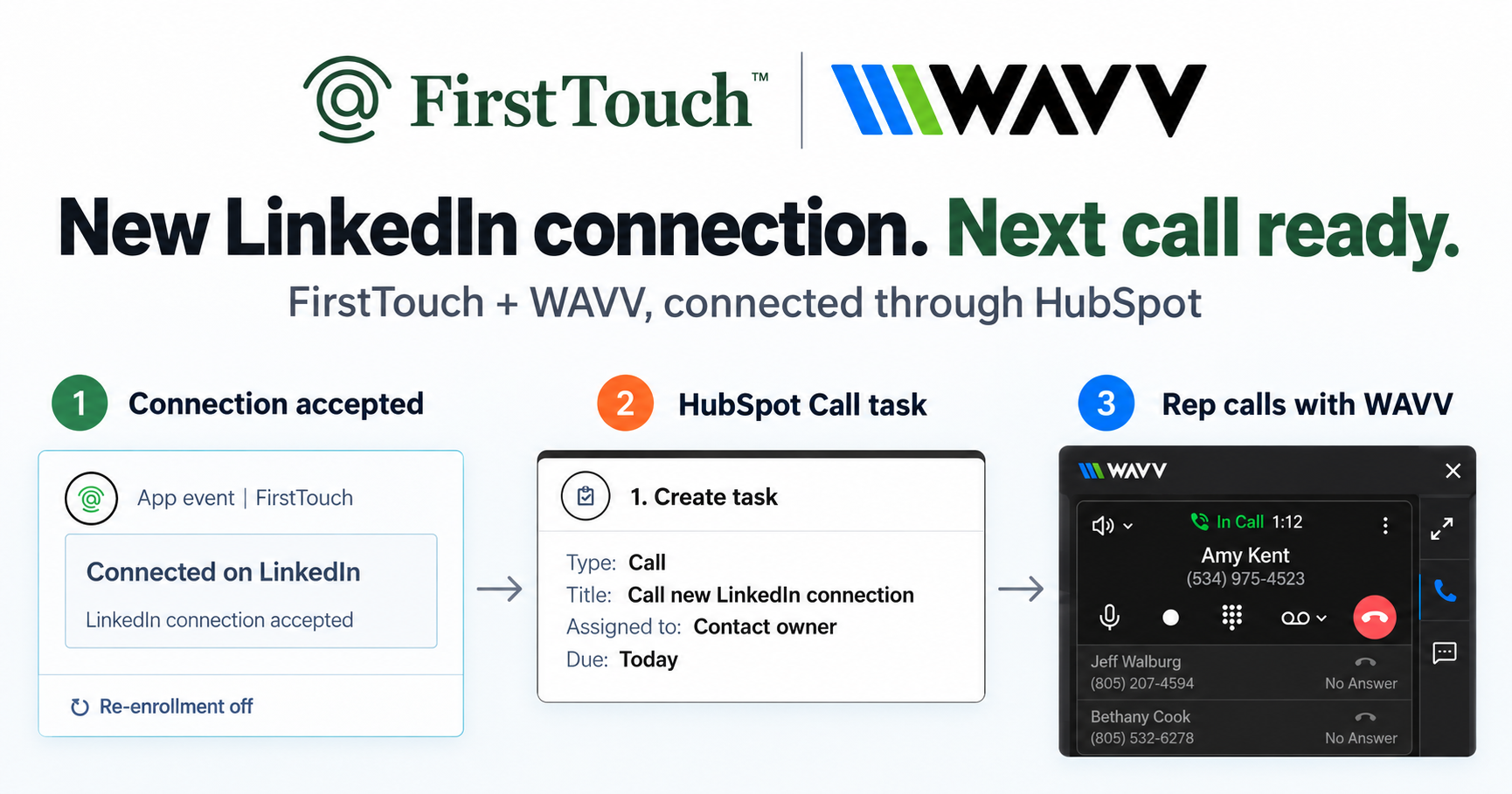
FirstTouch's activity history helps you follow what happened in the product. If a HubSpot record is also part of the workflow, verify it separately. HubSpot synchronization depends on the integration's settings, matching behavior and whether you are inspecting an activity or a task. Connecting HubSpot alone is not a substitute for checking those conditions.
See the HubSpot activity and task guide. HubSpot is optional for the API and MCP starting path; another CRM requires a separately established integration.
Use a review checklist for the first pilot
- Choose an internal test recipient and the intended connected sender.
- Write down the exact operation and the control that should hold it for review.
- Inspect the proposed content and relationship context.
- Observe the state before review, after a decline and after an explicitly authorized approval.
- Check the final action result. If it is unclear, inspect the existing action before considering a retry.
- Check the corresponding CRM record only if that integration is part of the pilot.
This is an evaluation checklist, not a runnable tutorial or a record of completed tests. Use the pilot worksheet to retain the configuration and observed results. Setup time depends on the client, account and workflow; plan for verification rather than a fixed time promise.
Is an approval-gated MCP server safe?
For workflows configured and verified to require review, the approval step is one part of the process. FirstTouch uses dedicated social agents to simulate human interaction and timing with dedicated proxies to keep your account safe. Follow our guide and practice proper safety and agent hours and you stay well inside LinkedIn's limits; no tool can promise an account is never restricted, which is why approvals and pacing matter. Keep pacing near 15 to 20 actions per rep per day, and never run two LinkedIn tools on one account; step one of the Safety Checklist is disconnecting the other one. 1M+ actions have been processed under approval, pacing, and audit. For the longer version, see is LinkedIn automation safe.
Start with one relationship-sensitive workflow
Pick a task where context matters: following up with an engaged prospect, preparing a reply or helping a relationship owner review the next touch. Keep the first scope small enough that your team can inspect every outcome.
Bring your workflow to a demo, or compare the options in our LinkedIn MCP guide. For client setup, use the current Claude or ChatGPT walkthrough.